

- 2024-10-03
Understanding the Costs of Experiencing Kyoto’s Traditional “Ozashiki” Banquet Play
In Kyoto’s traditional tea houses, you can experience ……

Kyoto’s five hanamachi run to a calendar, and it is published. The traditional arts foundation sets out what happens month by month — the opening ceremonies in January, the dances in spring, the one day in August when geiko and maiko call on their teachers, the recitals in October, and the start of the New Year preparations in December.
If you are choosing when to visit Kyoto, this is more useful than any amount of advice about standing in Gion at dusk. Here is the year, with what you can actually attend marked out.

| Ticketed and public | The spring dances, the June joint performance, the autumn recitals and the November dance |
| Public but not ticketed | The Gion Festival procession in July and the Jidai Matsuri in October |
| Visible but private | Hassaku on 1 August and Kotohajime from 13 December — street occasions, not events |
| Busiest month | April, with two dances running at once |
| The only autumn dance | Gion Odori, from 1 November |
| All five on one stage | Miyako no Nigiwai in June, at the Minamiza |
| Quietest stretch | September, which is given over to rehearsal |
| Caution | These are the usual dates; each edition is announced separately and moves |
Each district holds a shigyoshiki(始業式)to open the working year — on the 7th in Gion Kobu, Miyagawacho, Pontocho and Gion Higashi, and on the 9th in Kamishichiken. It is an internal occasion rather than a show, but the districts are at their most formal and the streets are worth walking.
At setsubun the geiko and maiko appear at the shrines: four of the districts at Yasaka Shrine, and Kamishichiken at Kitano Tenmangu. The tradition of obake(お化け), in which performers appear in costume other than their own, belongs to this night.
Later in the month, on 25 February, the Baika-sai plum blossom festival is held at Kitano Tenmangu, with Kamishichiken attending.
For a visitor, February is the sleeper month: free, outdoors and far less contested than April.
This is the main season, and the four spring dances run almost back to back.
Treat those opening dates as the usual pattern rather than a promise. The 2026 Kamogawa Odori, for instance, ran from 5 to 22 May rather than from the 1st. Each edition is announced on its own, which is why the dates need checking in the year you travel — how to see maiko in Kyoto has the current prices and booking details.

The Miyako no Nigiwai(都の賑い)is the joint performance of all five hanamachi, held at the Minamiza theatre. It began in 1994, for the 1,200th anniversary of the founding of the capital, and the 2026 edition was its 33rd.
That edition ran over two days, 27 and 28 June, with performances at eleven in the morning and half past two in the afternoon, and around seventy performers on stage. Tickets went on sale on 22 April at ten in the morning.
It is the one occasion in the year when the five districts appear together, which makes it the single best-value evening for a visitor who wants to see the range rather than one district’s style.
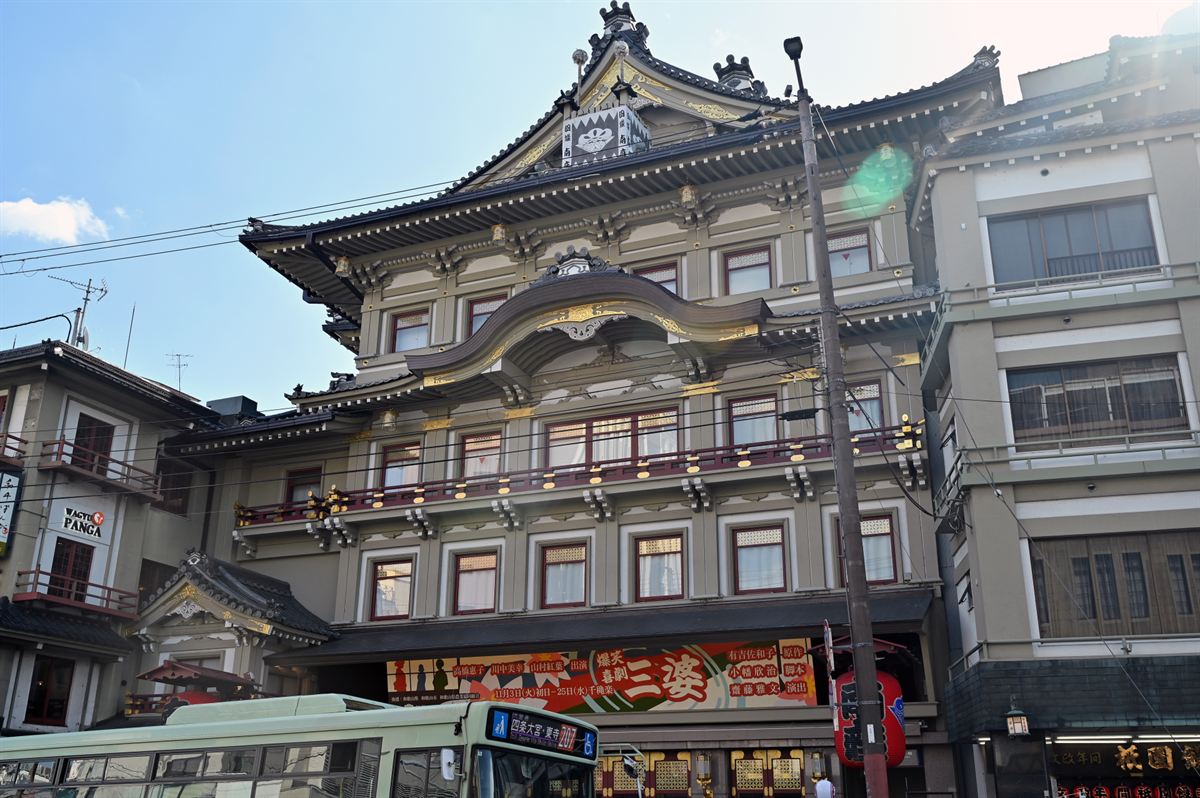
Nothing is on stage, and two of the year’s most photographed occasions happen anyway.
At the Gion Festival, the Hanagasa procession on 24 July includes geiko and maiko, with Gion Kobu and Miyagawacho alternating year by year with Pontocho and Gion Higashi. It is free and it is on a public route.
On 1 August comes Hassaku(八朔), the day when geiko and maiko go in formal black kimono to call on their teachers and the teahouses they work with, to thank them. It is not an event. It is a round of formal visits that happens to take place in public, and the sensible way to witness it is from a distance and briefly.

September is practice. Nothing public happens, and the districts are at their quietest.
October pays it off with the autumn recitals, one per district: the Onshukai in Gion Kobu, the Mizue-kai in Miyagawacho, the Suimei-kai in Pontocho and the Kotobuki-kai in Kamishichiken. These are smaller and more technical than the spring dances — closer to a recital than a revue — and correspondingly easier to get into.
The Jidai Matsuri, Kyoto’s procession of historical costume, falls on 22 October.
The Gion Odori(祇園をどり)opens on 1 November in Gion Higashi, and it is the only autumn stage performance among the five districts. Also in November is the Gion Kouta festival at Maruyama Park, held annually since 2003.
December has three things. A tea offering on the 1st at the Kamishichiken theatre. From the 13th, Kotohajime(事始め), when geiko and maiko visit their teachers and teahouses to mark the start of the New Year preparations — the winter counterpart of Hassaku, and the same etiquette applies. And the Kaomise at the Minamiza, the year-end kabuki run, which the districts attend together.
Which district you end up in matters too — Kyoto’s five hanamachi and which is which explains the differences. For the people behind the calendar, see the life and work of a maiko, and for the private end of it, what an ozashiki banquet costs.
April, when the Miyako Odori and the Kyo Odori both run from the start of the month. Late June is the alternative, when all five districts share one stage at the Minamiza.
The formal round of visits on 1 August, when geiko and maiko call on their teachers and the teahouses they work with, dressed in black. It happens in the street but it is not a performance, and it is a working obligation rather than an occasion laid on for visitors.
Not publicly. September is the rehearsal month ahead of the October recitals. If you are travelling then, Gion Corner’s evening programme is the reliable option.
The hanamachi year is more legible than it looks. Pick the month first, and the rest of the planning follows from it.
Last updated: November 2026. The dates above are the calendar’s usual pattern; each performance is announced edition by edition and the official information is published in Japanese. Please confirm before you book.
In Kyoto’s traditional tea houses, you can experience ……
Maiko, the graceful young women in white makeup and elegant ……
The bamboo path is 400 metres long and free, the sightseeing……
Kiyomizudera Temple, located in Kyoto’s Higashiyama di……


